




Physical Therapist Salary Growth: Trends & Predictions for 2025
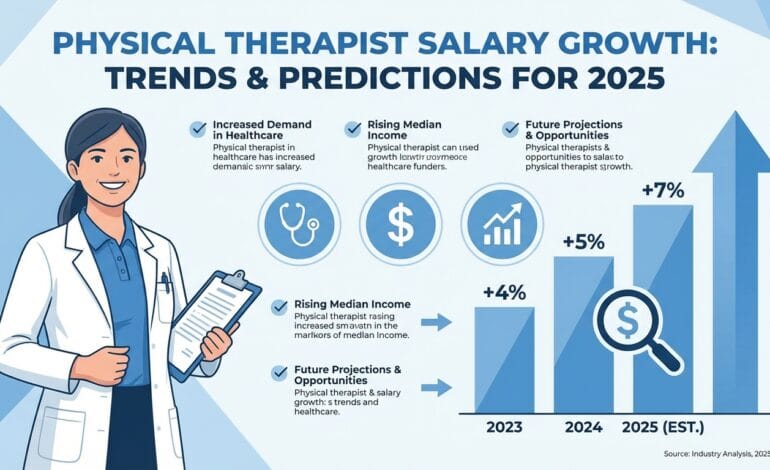

Table of contents
- Introduction
- 📈 Recent Salary & Job‑Market Benchmarks (US & Global)
- Employment Growth Outlook
- Global and Industry Trends
- What Is Driving physical therapist salary Growth — Key Factors
- 3. Technological Innovation & New Care Models
- Forecast & Predictions — What PT Salary Growth Could Look Like by 2028–2035
- Challenges & Risks That Could Affect Growth
- What This Means for Aspiring & Practicing PTs — Strategic Advice
- FAQ — Common Questions & Answers about PT Salary Growth
- Conclusion — Why 2025 Is a Pivotal Year for physical therapist salary
Introduction
Physical therapy is changing all the time because of new healthcare needs, more older patients, new technology, and different ways clinics run.
As 2025 approaches, many physical therapists—both beginners and experienced—are asking, “Will pay go up?”
This article looks at recent salary trends, the main factors that affect pay, and predictions for the future. It will help you plan your career, understand the job market, and negotiate your salary more effectively.
📈 Recent Salary & Job‑Market Benchmarks (US & Global)
US Current Salary and Demand
- According to the U.S. Bureau of Labor Statistics (BLS), the median annual wage for physical therapists was US $101,020 in May 2024. Bureau of Labor Statistics
- Other sources for 2025 show average PT salary at around US $105,801 per year (≈ US $51/hour). career.com+1
- Pay varies by work setting: PTs working in home‑health services, nursing/residential care, and hospitals tend to have higher median wages relative to some outpatient or therapist-office settings. Bureau of Labor Statistics
Employment Growth Outlook
The demand for physical therapists is strong. According to the Bureau of Labor Statistics, employment for PTs is expected to grow 11% from 2024 to 2034, which is much faster than the average for all jobs.
A 2025 workforce forecast warns that there could be a shortage of PTs. Even though more therapists are entering the workforce, demand is growing faster than supply, which could lead to gaps in many areas.
The number of licensed PTs is rising, but factors like an aging population, chronic muscle and joint problems, and focus on rehabilitation keep the demand high.
Global and Industry Trends
The global market for physical therapy services is worth tens of billions of dollars, and demand is expected to keep growing.
New technologies like telehealth, virtual rehabilitation, remote monitoring, robotic-assisted therapy, and digital health tools are changing how physical therapy is delivered and helping therapists reach more patients.
Healthcare is also shifting toward preventive care, rehabilitation instead of surgery, chronic pain management, and overall wellness. This creates more opportunities for physical therapists and could lead to higher demand and better pay over time.
What Is Driving physical therapist salary Growth — Key Factors
Several interlocking trends and factors are shaping the growth in demand and salary potential for physical therapists:
1. Aging Population & Chronic Disease Prevalence
As populations in many countries age, the incidence of mobility issues, musculoskeletal disorders, chronic pain, post-surgery rehab, stroke, and arthritis increases. These conditions often require long-term physical therapy, boosting demand for qualified PTs. georgefox.edu+2apta.org+2
Additionally, rising rates of obesity, sedentary lifestyles, and chronic diseases increase demand for rehabilitative and preventive therapy. Bureau of Labor Statistics+2bigdreamersaba.com+2
2. Shift Toward Preventive, Value‑Based & Outcome‑Based Care
Healthcare systems are increasingly emphasizing preventive care and non-pharmacological interventions (e.g., physical therapy) to reduce long‑term costs and improve quality of life. grandviewresearch.com+2Tech Hub at Porterchester+2
This shift raises the value of PT services, making them more central to patient care — which tends to increase demand and justify higher compensation. grandviewresearch.com+2aiintherapy.com+2
3. Technological Innovation & New Care Models
Physical therapy is no longer just about in-person clinic visits. New technologies like tele-rehabilitation, remote monitoring, wearable trackers, robotic-assisted therapy, and virtual reality are allowing PTs to help more patients, even in different locations.
These innovations also make hybrid care (both in-person and virtual), home-based therapy, and digital PT services possible. This creates more job opportunities and could increase income for physical therapists, especially those who are comfortable using new technology.
4. Workforce Shortages & Supply‑Demand Mismatch
Despite growth in the number of PTs, some forecasts show that demand will exceed supply — creating a shortage that could translate into higher wages and better working conditions for PTs, especially in underserved regions. OUP Academic+1
With many PTs reportedly over capacity and unable to meet demand (according to recent surveys), clinics and health systems may need to offer higher wages, bonuses, or incentives to attract and retain talent. apta.org+2georgefox.edu+2
5. Specialization, Certifications & Advanced Roles
PTs who specialize — e.g., in orthopedics, sports therapy, neurology, geriatrics — or who gain certifications, manage private practices, or work in high-demand niches may command higher pay. American Profession Guide+2careerguidepro.com+2
As care becomes more complex and outcome-driven, demand grows for highly skilled, certified PTs — which tends to push up compensation compared to general practitioners.
6. Changing Patient Expectations & Consumer Behavior
Patients increasingly expect personalized care, measurable outcomes, convenience (home‑therapy/telehealth), and holistic wellness — all trends that favor PT services. sprypt.com+2Tech Hub at Porterchester+2
As PTs adapt to these new expectations (e.g., remote plans, digital check-ins, data-driven rehab), their services may be valued more — potentially contributing to higher pay.
Forecast & Predictions — What PT Salary Growth Could Look Like by 2028–2035
Based on the trends and data, here’s what we might reasonably expect for physical therapist salary and demand in the near to medium future:
| Year / Period | What to Expect | Implication for PTs’ Earnings & Careers |
|---|---|---|
| 2025–2028 | Continued demand growth, modest to moderate wage increases (in line with inflation and demand) | Salaries may rise modestly (~2–5% annually), especially for experienced & specialized PTs |
| 2028–2032 | Supply‑demand gap may widen if the workforce doesn’t keep up with demand; preventive care and rehab become more central in healthcare | Potential for higher wages, bonuses, and incentive-based pay; more demand for experienced PTs, privatization or contract-based work |
| 2030–2035 | Broader adoption of tele‑rehab, hybrid and tech‑enabled therapy models; outcome-based funding/reimbursement; expanding chronic care and aging population needs | PTs skilled in tech-enabled care, tele‑therapy, or specialized practice may command premium pay; fewer generalists, more niche specialists |
| Long-term (2035+) | Consolidation or specialization of PT practices; regulatory/insurance shifts, higher credential requirements; larger clinics or PT‑led wellness centers | High competition for top PT roles; those with advanced certifications, multi-disciplinary skills, or business ownership may earn significantly more; general PT roles may stagnate |
Overall Prediction: A steady upward trajectory in demand and compensation for PTs — but with greater stratification: specialized, tech‑savvy, or entrepreneurial PTs likely to benefit more than general practitioners.
Challenges & Risks That Could Affect Growth
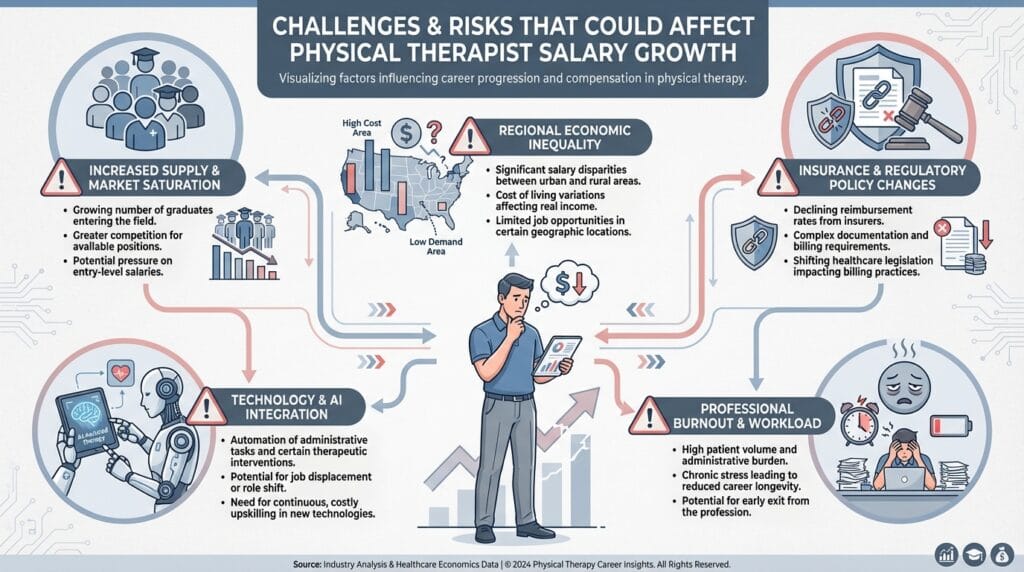
Not all is certain. There are some caveats and potential risks that could affect physical therapist salary growth for PTs:
- More PTs entering the workforce: If training programs produce more therapists than the demand, supply could catch up, which may slow salary growth.
- Changes in healthcare policy and insurance: Cuts in insurance payments, new regulations, or cost-saving measures in healthcare could limit how much PTs earn.
- Technology replacing routine work: Remote rehab, AI-guided therapy, and robotic-assisted PT may reduce demand for some basic or repetitive tasks.
- Burnout and turnover: High stress or burnout could lead PTs to leave, causing unstable wages or working conditions.
- Pay inequality: PTs in rural areas, low-income regions, or general practices may see slower salary growth than those in urban or specialized settings.
What This Means for Aspiring & Practicing PTs — Strategic Advice
If you plan to work (or continue to work) as a PT, here is how you can position yourself to benefit from the expected physical therapist salary growth:
Specialize or get advanced certification: Choose areas like sports, orthopedics, neurology, geriatrics, or pain management. Specialized PTs often earn more.
Learn technology and tele-rehab skills: Remote sessions, digital patient monitoring, and telehealth platforms can make you more in demand.
Focus on outcome-based, patient-centered care: PTs who deliver strong results and track outcomes are more valued in the shift to value-based care.
Consider private practice or entrepreneurship: Independent practices or mobile PT may offer higher earning potential than salaried jobs.
Stay adaptable and update credentials: Continuing education and learning new care models keeps you competitive.
Target high-demand locations: Rural or underserved areas often have shortages and may offer better pay or incentives.
FAQ — Common Questions & Answers about PT Salary Growth
A: Yes — most indicators point to continued demand growth (aging population, chronic conditions, preventive care), which should support steady if moderate salary growth, especially for experienced or specialized PTs.
A: Yes. PTs with advanced certifications or specialized skills (e.g., ortho, sports rehab, neuro, geriatrics) tend to command higher wages — especially as care becomes more complex and outcome-driven.
A: It’s possible some routine PT work may become more efficient or even partially automated/remote — but that also opens up new niches (tele-rehab, remote monitoring, hybrid care). PTs who adapt will likely benefit; those who don’t may face lower demand.
A: That is a potential risk. However, recent supply‑demand forecasts (as of 2025) still show a projected shortfall — suggesting demand may continue to outpace supply if retention and new entries don’t keep up.
A: That’s increasingly a smart move. As hybrid care models, remote therapy, wearables, and digital health become more common, PTs with digital fluency will likely be more in demand and better compensated.
Conclusion — Why 2025 Is a Pivotal Year for physical therapist salary
2025 stands out as a significant time for physical therapy: demand continues to rise, patient expectations evolve, care models shift toward prevention and value-based outcomes, and technology is transforming how therapy is delivered. For PTs — whether new graduates or seasoned practitioners — there are real opportunities for growth.
However, these opportunities come with responsibility. To truly benefit, PTs must adapt, specialize, and stay current with developments in healthcare, tech, and patient care models. For those who do — the coming years could bring solid income growth, stronger job security, and more diversified career paths.
more Go Home