


Table of contents
- What is Evidence?
- Why Use Evidence Synonyms?
- 50+ Evidence Synonyms for Different Contexts
- How to Choose the Right Evidence Synonym
- Common Mistakes When Using Evidence Synonyms
- Tips for Integrating Evidence in Writing
- SEO Tips for Using Evidence Synonyms
- Examples of Using Evidence Synonyms in Sentences
- FAQs About Evidence Synonyms
- 1. What is the best synonym for evidence in academic writing?
- 2. Can I use “proof” instead of “evidence”?
- 3. Are all evidence synonyms interchangeable?
- 4. How can I make my writing more diverse using evidence synonyms?
- 5. Is “supporting documentation” a good synonym for evidence?
- 6. Can I use evidence synonyms for SEO content?
- 7. How many evidence synonyms are enough in one article?
- Conclusion
In academic writing, research papers, professional reports, or even everyday communication, the word “evidence” plays a crucial role. However, overusing it can make your writing repetitive and less engaging. Whether you are drafting an essay, crafting a research paper, or preparing a report, knowing the right evidence synonym can elevate the quality of your work.
In this comprehensive guide, we’ll explore over 50 alternatives to the word “evidence,” discuss their meanings, and explain when and how to use them effectively. We’ll also answer frequently asked questions about choosing the right synonym to make your writing precise, persuasive, and professional.
What is Evidence?
Before diving into synonyms, it’s essential to understand what evidence means. Evidence refers to:
- Facts, data, or information supporting a claim.
- Proof of a theory, argument, or statement.
- Material used to demonstrate the truthfulness or validity of something.
In simple terms, evidence is anything that backs up your claims or opinions. Depending on the context, evidence can be statistical data, testimonials, research findings, examples, or visual proof.
Why Use Evidence Synonyms?

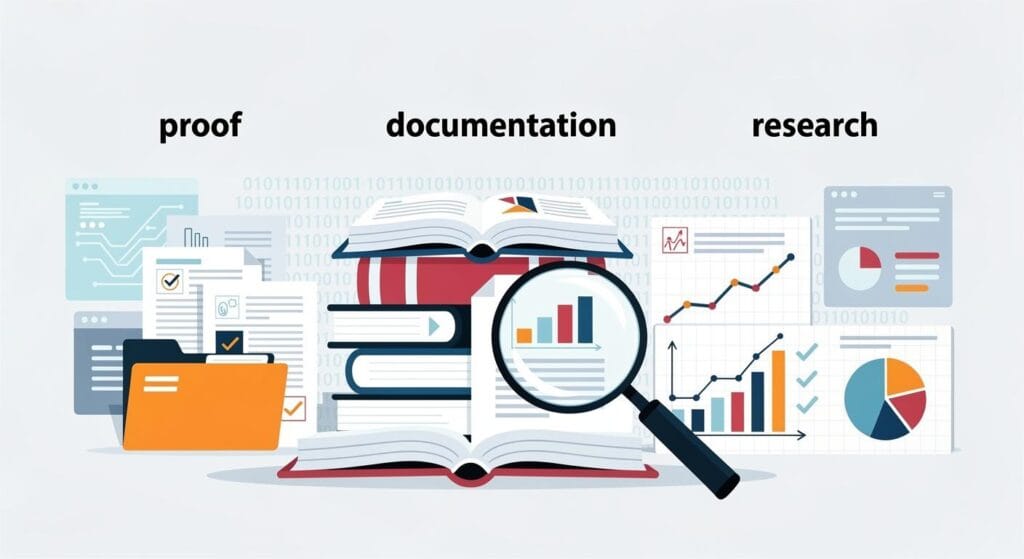
Using evidence synonyms has several benefits:
- Avoids repetition – Repeating the word “evidence” in a paragraph can make your writing monotonous.
- Enhances clarity – Some synonyms are more specific and help you convey your point better.
- Improves style – Using a variety of terms makes your writing sound professional and sophisticated.
- Contextual appropriateness – Different words work better depending on whether you are writing academically, legally, or informally.
50+ Evidence Synonyms for Different Contexts
Here’s a detailed list of over 50 evidence synonyms categorized for academic, professional, and general usage.
Academic & Research Writing
- Proof – Strong, undeniable confirmation.
- Documentation – Records supporting a claim.
- Data – Numerical or statistical evidence.
- Empirical support – Evidence based on observation or experiment.
- Corroboration – Something that confirms or strengthens a statement.
- Validation – Confirmation of accuracy or truth.
- Substantiation – Providing solid grounds for an argument.
- Confirmation – Evidence that makes a claim certain.
- Demonstration – Showing proof through example or experiment.
- Illustration – Example that clarifies a point.
Legal & Formal Contexts
- Testimony – Statement given by a witness.
- Exhibit – Document or object presented in court.
- Attestation – Formal confirmation of authenticity.
- Witness – Person providing proof.
- Authentication – Process of verifying validity.
- Certification – Official confirmation of facts.
- Verification – Establishing truth or accuracy.
Everyday & General Writing
- Sign – Indication of a fact or phenomenon.
- Indication – Something showing that a claim is true.
- Clue – Suggestion or hint pointing to evidence.
- Trace – Remnant proving occurrence.
- Mark – Sign that serves as evidence.
- Token – Symbolic representation of proof.
- Hint – Subtle form of evidence.
- Lead – Information guiding toward confirmation.
Specialized Contexts
- Finding – Conclusion from research or investigation.
- Observation – Evidence from noticing details.
- Record – Documented evidence of events or data.
- Fact – Confirmed and objective truth.
- Statistic – Numerical representation supporting a claim.
- Case study – Detailed investigation as evidence.
- Example – Demonstrative instance supporting a claim.
- Instance – Specific occurrence serving as proof.
- Excerpt – Part of text serving as evidence.
- Quotation – Cited statement providing proof.
Advanced & Formal Alternatives
- Indication – Suggestive proof.
- Manifestation – Clear demonstration of a fact.
- Exemplification – Illustration through example.
- Confirmation – Supporting fact.
- Corroborative proof – Strong, supplementary evidence.
- Attestation – Official or sworn evidence.
- Substantiating material – Concrete supporting information.
- Supporting documentation – Records that validate claims.
- Empirical evidence – Proof obtained through experiments or observation.
- Analytical data – Evidence derived from analysis.
- Verified source – Trusted information backing claims.
- Observation record – Documented observation supporting a fact.
- Demonstrative evidence – Evidence demonstrating a point visually or practically.
- Probative material – Evidence legally or logically significant.
- Confirmatory information – Data or details that confirm statements.
- Recorded proof – Evidence documented for future reference.
- Physical evidence – Tangible evidence such as objects or materials.
- Corroborative documentation – Additional proof supporting primary evidence.
How to Choose the Right Evidence Synonym
Choosing the right evidence synonym depends on your writing style, audience, and context:
- Academic papers: Use terms like empirical support, corroboration, substantiation, validation.
- Legal writing: Go for testimony, exhibit, attestation, probative material.
- Professional reports: Opt for documentation, confirmation, supporting material, analytical data.
- Everyday writing: Words like sign, hint, clue, example are sufficient and reader-friendly.
Tip: Always ensure the synonym matches the nuance of your sentence. For example, “clue” is informal and suggestive, while “substantiation” is formal and authoritative.
Common Mistakes When Using Evidence Synonyms
Even with a variety of synonyms, writers can make mistakes:
- Using informal synonyms in formal writing: Avoid words like “clue” or “hint” in research papers.
- Misunderstanding nuances: Not every synonym is interchangeable. For instance, “proof” implies certainty, while “indication” implies suggestion.
- Overcomplicating sentences: Using overly technical synonyms may confuse readers. Keep readability in mind.
Tips for Integrating Evidence in Writing
- Cite properly: Always mention your sources, even when using synonyms.
- Be specific: Instead of saying “evidence shows,” mention the type of evidence, like “statistical evidence shows.”
- Use variety: Mix simple and advanced synonyms to keep the text engaging.
- Align with tone: Match the synonym to the tone of your article or report.
SEO Tips for Using Evidence Synonyms
For SEO purposes:
- Keyword placement: Naturally include “Evidence Synonym” in the title, headers, and first 100 words.
- Long-tail keywords: Use phrases like “alternative words for evidence,” “evidence synonyms in research,” or “substitute for evidence.”
- Internal linking: Link to related content like research writing tips or synonyms guides.
- Content readability: Use short paragraphs, bullet points, and examples for better user engagement.
- Meta description example: “Discover 50+ evidence synonyms for writing and research. Improve your essays, reports, and articles with the right alternatives for evidence.”
Examples of Using Evidence Synonyms in Sentences
- Proof: “The data provides proof that the new method is effective.”
- Corroboration: “Several studies offer corroboration for this hypothesis.”
- Testimony: “The witness’s testimony supported the prosecution’s claim.”
- Clue: “The detective found a clue that led to the suspect.”
- Observation: “Direct observation confirmed the experiment’s results.”
FAQs About Evidence Synonyms
1. What is the best synonym for evidence in academic writing?
Answer: Words like empirical support, corroboration, substantiation, and validation work best as they maintain formal tone and clarity.
2. Can I use “proof” instead of “evidence”?
Answer: Yes, but “proof” implies certainty, while “evidence” can be partial or suggestive. Use “proof” when you are confident about the claim.
3. Are all evidence synonyms interchangeable?
Answer: No. Synonyms have subtle differences. For example, “clue” is informal, and “attestation” is formal. Always match the synonym to the context.
4. How can I make my writing more diverse using evidence synonyms?
Answer: Mix simple synonyms like sign, clue, example with formal ones like substantiation, corroboration, verification. Use them where contextually appropriate.
5. Is “supporting documentation” a good synonym for evidence?
Answer: Yes, especially in professional or corporate reports. It refers to documents that substantiate claims or provide proof.
6. Can I use evidence synonyms for SEO content?
Answer: Absolutely. Using different synonyms makes your content natural and avoids keyword stuffing while still targeting “evidence synonym” for search engines.
7. How many evidence synonyms are enough in one article?
Answer: It depends on the article length. In a 2000-word article, using 10-15 different synonyms ensures variety without confusing readers.
Conclusion
Mastering evidence synonyms is crucial for improving your writing, whether you are a student, researcher, or professional. Using the right synonym helps you avoid repetition, enhance clarity, and maintain an authoritative tone.
With over 50 alternatives at your disposal, you can confidently adapt your writing to any context—academic, legal, professional, or everyday use. Remember to match the synonym with context, provide proper citations, and maintain readability.
Next time you’re about to write “evidence shows,” try one of these alternatives to make your writing more dynamic and engaging.


