


Table of contents
- 1. What Is a Memory Foam Mattress?
- 2. How Does a Memory Foam Mattress Work?
- 3. What Are the Benefits of a Memory Foam Mattress?
- 4. Are Memory Foam Mattresses Good for Back Pain?
- 5. Who Should Use a Memory Foam Mattress?
- 6. Top Picks: Best Memory Foam Mattresses for Comfort and Support
- 7. What Firmness Level Is Best for a Memory Foam Mattress?
- 8. Do Memory Foam Mattresses Sleep Hot?
- 9. How Long Does a Memory Foam Mattress Last?
- 10. What Is Foam Density and Why Does It Matter?
- 11. Memory Foam Mattress vs Spring Mattress
- 12. Is a Memory Foam Mattress Good for Couples?
- 13. Can Memory Foam Mattresses Be Used on Any Bed Frame?
- 14. Are Memory Foam Mattresses Safe?
- 15. How to Choose the Best Memory Foam Mattress
- 16. Do Memory Foam Mattresses Need a Break-In Period?
- 17. Memory Foam Mattress Maintenance Tips
- 18. Are Memory Foam Mattresses Good for Heavy Sleepers?
- 20. Final Verdict: Is a Memory Foam Mattress Worth It?
Choosing the best memory foam mattress can completely transform your sleep quality. From relieving pressure points to providing excellent body contouring, memory foam mattresses are one of the most popular choices for people seeking comfort, support, and motion isolation. In this detailed FAQ guide, we’ll cover everything you need to know about memory foam mattresses, including benefits, how they work, top picks, and how to choose the right one for your needs.
1. What Is a Memory Foam Mattress?
A memory foam mattress is made from viscoelastic foam that reacts to body heat and pressure. It softens under warmth and molds to your body’s shape, then slowly returns to its original form when pressure is removed.
Key Characteristics:
- Body-contouring support
- Pressure relief for joints
- Motion isolation
- Even weight distribution
Memory foam mattresses are ideal for sleepers who want personalized comfort and reduced pressure on sensitive areas like shoulders, hips, and lower back.
2. How Does a Memory Foam Mattress Work?
Memory foam works by responding to heat and pressure:
- Your body heat softens the foam
- The foam conforms to your shape
- Pressure points are evenly supported
- When you move, the foam slowly rebounds
This creates a “hugging” feel that supports natural spinal alignment.
3. What Are the Benefits of a Memory Foam Mattress?
✅ Pressure Relief
Memory foam distributes body weight evenly, reducing stress on joints and muscles.
✅ Spinal Alignment
It supports the natural curve of the spine, which helps reduce back pain.
✅ Motion Isolation
Ideal for couples—movement on one side doesn’t disturb the other.
✅ Comfort for All Sleep Positions
Works well for side, back, and combination sleepers.
✅ Quiet & Durable
No springs means no noise and long-lasting performance.
4. Are Memory Foam Mattresses Good for Back Pain?
Yes. Memory foam mattresses are often recommended for people with back pain because they:
- Support spinal alignment
- Reduce pressure on the lower back
- Adapt to individual body shapes
Medium-firm memory foam mattresses are usually the best choice for back pain sufferers.
5. Who Should Use a Memory Foam Mattress?
Memory foam mattresses are ideal for:
- Side sleepers
- Back sleepers
- Couples
- People with joint pain
- Light to average-weight sleepers
They may not be ideal for people who prefer a very firm or bouncy mattress.
6. Top Picks: Best Memory Foam Mattresses for Comfort and Support

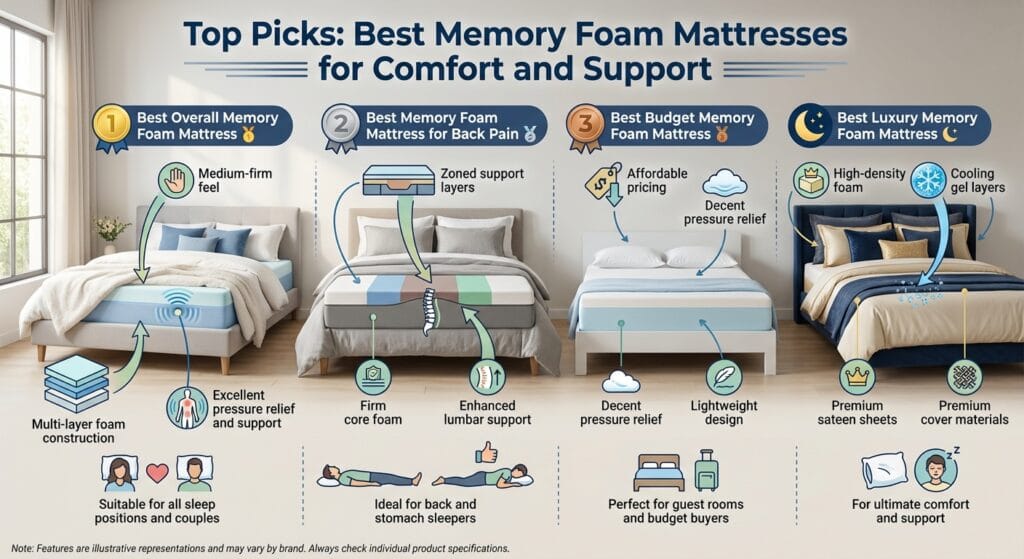
🥇 Best Overall Memory Foam Mattress
Features:
- Medium-firm feel
- Multi-layer foam construction
- Excellent pressure relief and support
Best for: All sleep positions and couples
🥈 Best Memory Foam Mattress for Back Pain
Features:
- Zoned support layers
- Firm core foam
- Enhanced lumbar support
Best for: Back and stomach sleepers
🥉 Best Budget Memory Foam Mattress
Features:
- Affordable pricing
- Decent pressure relief
- Lightweight design
Best for: Guest rooms and budget buyers
🌙 Best Luxury Memory Foam Mattress
Features:
- High-density foam
- Cooling gel layers
- Premium cover materials
Best for: People seeking hotel-level comfort
7. What Firmness Level Is Best for a Memory Foam Mattress?
| Sleep Type | Recommended Firmness |
|---|---|
| Side Sleepers | Soft to Medium |
| Back Sleepers | Medium to Medium-Firm |
| Stomach Sleepers | Medium-Firm to Firm |
| Couples | Medium |
Medium firmness is the most popular because it balances comfort and support.
8. Do Memory Foam Mattresses Sleep Hot?
Traditional memory foam can retain heat, but modern mattresses include cooling technologies, such as:
- Gel-infused foam
- Open-cell foam structure
- Breathable covers
- Copper or charcoal infusions
If you sleep hot, look for a cooling memory foam mattress.
9. How Long Does a Memory Foam Mattress Last?
A high-quality memory foam mattress typically lasts:
- 7–10 years with proper care
Factors that affect lifespan:
- Foam density
- Body weight
- Usage frequency
- Mattress care and rotation
10. What Is Foam Density and Why Does It Matter?
Foam density affects durability and support.
| Density | Quality |
|---|---|
| 2–3 lbs | Low density (budget) |
| 3–4 lbs | Medium density (balanced) |
| 4–5+ lbs | High density (premium) |
Higher density foam usually lasts longer and offers better support.
11. Memory Foam Mattress vs Spring Mattress
| Feature | Memory Foam | Spring Mattress |
|---|---|---|
| Comfort | High | Moderate |
| Motion Isolation | Excellent | Poor |
| Pressure Relief | Excellent | Limited |
| Bounce | Low | High |
| Noise | Silent | Can squeak |
Memory foam is best for comfort and support, while springs offer more bounce.
12. Is a Memory Foam Mattress Good for Couples?
Yes. Memory foam mattresses are excellent for couples because:
- Minimal motion transfer
- Quiet sleep experience
- Consistent support across the surface
Couples with different sleep preferences may benefit from medium-firm memory foam.
13. Can Memory Foam Mattresses Be Used on Any Bed Frame?
Memory foam mattresses work well on:
- Platform beds
- Adjustable bases
- Slatted frames (with proper spacing)
- Solid foundations
Avoid placing directly on uneven surfaces.
14. Are Memory Foam Mattresses Safe?
Most modern memory foam mattresses are:
- CertiPUR-US certified
- Free from harmful chemicals
- Low-VOC (minimal off-gassing)
A slight odor when new is normal and fades within a few days.
15. How to Choose the Best Memory Foam Mattress
Choosing the right memory foam mattress is crucial for comfort, support, and long-term sleep health. Memory foam mattresses vary in density, firmness, cooling technology, and construction. Here’s a detailed step-by-step guide to help you make the best choice.
1. Consider Your Sleep Position
Your sleep position greatly influences the type of mattress that will provide optimal support. Memory foam molds to your body, so matching the mattress to your sleeping style ensures spinal alignment and comfort.
- Side Sleepers:
Need a softer mattress that cushions shoulders and hips to reduce pressure points. Medium-soft to medium firmness is ideal. - Back Sleepers:
Medium to medium-firm mattresses work best, supporting the natural curve of the spine while relieving pressure on the lower back. - Stomach Sleepers:
Firm mattresses prevent the hips from sinking too much, keeping the spine aligned. Medium-firm to firm is recommended. - Combination Sleepers:
A versatile medium-firm mattress is suitable for people who change positions throughout the night.
Choosing the right firmness based on sleep position ensures comfort, prevents back pain, and promotes restful sleep.
2. Check Foam Density
Foam density measures how much material is packed into a cubic foot of foam and affects durability, support, and feel.
- Low-Density Foam (2–3 lbs):
Affordable and soft, but may sag faster and provide less support. Suitable for light sleepers or temporary beds. - Medium-Density Foam (3–4 lbs):
Balanced comfort and support, lasts longer, ideal for most sleepers. - High-Density Foam (4–5+ lbs):
Premium quality, highly durable, excellent for heavy sleepers and long-term use.
Higher density foam offers better pressure relief and prevents premature sagging, making it a smart investment for quality sleep.
3. Look for Cooling Features
Traditional memory foam can retain heat, which may lead to uncomfortable, sweaty sleep. Modern memory foam mattresses include features to regulate temperature:
- Gel-Infused Foam: Absorbs and disperses heat for a cooler sleep surface.
- Open-Cell Foam: Allows better airflow within the mattress layers.
- Breathable Covers: Fabric that wicks away moisture and enhances ventilation.
- Copper or Charcoal Infusion: Naturally improves heat dissipation and odor control.
If you tend to sleep hot, a cooling memory foam mattress is essential for uninterrupted, comfortable sleep.
4. Choose the Right Firmness
Firmness determines how soft or hard the mattress feels and impacts spinal alignment and pressure relief.
- Soft: Feels plush, cushions joints, ideal for side sleepers.
- Medium: Offers balanced support and comfort, works for most sleep positions.
- Firm: Supports the spine for back and stomach sleepers, prevents sagging.
Many memory foam mattresses combine layered foam designs to provide contouring comfort on the surface while offering firm support in the core. Choosing the correct firmness prevents back pain and improves sleep quality.
5. Review Trial Period & Warranty
A mattress is a long-term investment. Many memory foam manufacturers offer trial periods and warranties, which are important for risk-free purchases.
- Trial Period: Allows you to test the mattress at home, usually 90–120 nights. Check if returns are easy and if shipping is free.
- Warranty: Covers manufacturing defects and sagging over a certain depth (typically 1–2 inches). Look for at least a 10-year warranty for peace of mind.
Trial periods and warranties ensure you have time to evaluate comfort and durability, reducing the risk of buyer’s remorse.
16. Do Memory Foam Mattresses Need a Break-In Period?
Yes. Most memory foam mattresses require:
- 2–4 weeks to fully expand and soften
Your body may also need time to adjust to the new support.
17. Memory Foam Mattress Maintenance Tips
- Rotate every 3–6 months
- Use a mattress protector
- Avoid jumping or bending
- Keep it clean and dry
Proper care extends mattress life significantly.
18. Are Memory Foam Mattresses Good for Heavy Sleepers?
Yes, but heavy sleepers should choose:
- High-density foam
- Medium-firm to firm feel
- Thick support layers
This ensures durability and proper spinal support.
Memory Foam Mattress FAQ
1. What is a memory foam mattress?
A memory foam mattress is made from viscoelastic foam that responds to body heat and pressure. It molds to your body, providing personalized support and pressure relief while slowly returning to its original shape.
2. How does a memory foam mattress work?
Memory foam softens under body heat and weight, contouring to your shape. It evenly distributes weight, reduces pressure points, and supports proper spinal alignment for better sleep quality.
3. What are the benefits of a memory foam mattress?
- Excellent pressure relief for joints and muscles
- Supports spinal alignment
- Reduces motion transfer between partners
- Comfortable for side, back, and combination sleepers
- Quiet and durable due to lack of springs
4. Are memory foam mattresses good for back pain?
Yes, medium-firm memory foam mattresses are often recommended for back pain. They support spinal alignment and reduce stress on lower back muscles.
5. Who should use a memory foam mattress?
- Side and back sleepers
- People with joint or back pain
- Couples (due to motion isolation)
- Light to average-weight sleepers
6. How long does a memory foam mattress last?
A high-quality memory foam mattress lasts approximately 7–10 years with proper care. Foam density, weight, and usage frequency can affect longevity.
7. What is foam density, and why does it matter?
Foam density affects support, durability, and feel:
- Low-density (2–3 lbs): Affordable but less durable
- Medium-density (3–4 lbs): Balanced comfort and support
- High-density (4–5+ lbs): Premium durability and support
8. Do memory foam mattresses sleep hot?
Traditional memory foam can retain heat, but modern mattresses often include cooling technologies like gel infusion, open-cell foam, or breathable covers to regulate temperature.
9. Can memory foam mattresses be used on any bed frame?
Yes, they work on:
- Platform beds
- Adjustable bases
- Slatted frames (with proper spacing)
- Solid foundations
Avoid uneven surfaces to maintain support and durability.
10. Are memory foam mattresses safe?
Most modern memory foam mattresses are CertiPUR-US certified, low in VOCs, and free from harmful chemicals. A slight off-gassing smell when new is normal and disappears after a few days.
11. How firm should a memory foam mattress be?
- Side sleepers: Soft to medium
- Back sleepers: Medium to medium-firm
- Stomach sleepers: Medium-firm to firm
- Couples: Medium is usually best for comfort and support balance
12. Can memory foam mattresses reduce motion transfer?
Yes. The viscoelastic foam absorbs movement, so a partner’s tossing and turning won’t disturb your sleep.
13. How do I maintain my memory foam mattress?
- Rotate 3–6 months for even wear
- Use a mattress protector
- Avoid bending or jumping on it
- Keep it clean and dry
14. Do memory foam mattresses require a break-in period?
Yes. Allow 2–4 weeks for the foam to fully expand and soften. Your body may also take time to adjust to the new support.
15. Are memory foam mattresses good for heavy sleepers?
Yes, but heavy sleepers should choose high-density foam with medium-firm to firm support to prevent sagging and maintain durability.
16. What types of memory foam mattresses are available?
- Traditional memory foam
- Gel-infused memory foam (cooling)
- Plant-based/eco-friendly memory foam
- Layered hybrid foam with support cores
17. How do I choose the best memory foam mattress?
Consider:
- Sleep position
- Foam density
- Firmness preference
- Cooling features
- Trial period and warranty
18. Do memory foam mattresses work well for couples?
Yes. Memory foam isolates motion, supports multiple sleep positions, and provides a quiet, comfortable surface for partners.
19. Are memory foam mattresses better than spring mattresses?
Memory foam excels in comfort, pressure relief, and motion isolation. Spring mattresses offer more bounce but less contouring support. Choose based on personal comfort preference.
20. Is a memory foam mattress worth the investment?
Absolutely. If you prioritize comfort, pressure relief, spinal alignment, and quiet sleep, a memory foam mattress provides years of improved sleep quality and is often worth the cost.
20. Final Verdict: Is a Memory Foam Mattress Worth It?
A memory foam mattress is a smart investment for anyone seeking better sleep, reduced pain, and long-term comfort. With the right firmness, density, and cooling features, it can provide years of restful, supportive sleep.
If you value comfort, pressure relief, and quiet sleep, a memory foam mattress is one of the best choices you can make.


